
Black Nightshade: Solanum nigrum


There are plants that announce themselves.
The mandrake thrusts its strange root from the earth. Brugmansia hangs its enormous trumpets in the evening air. Belladonna carries its dark berries beneath a name that became synonymous with deadly beauty.
And then there is black nightshade.
Solanum nigrum is quieter.
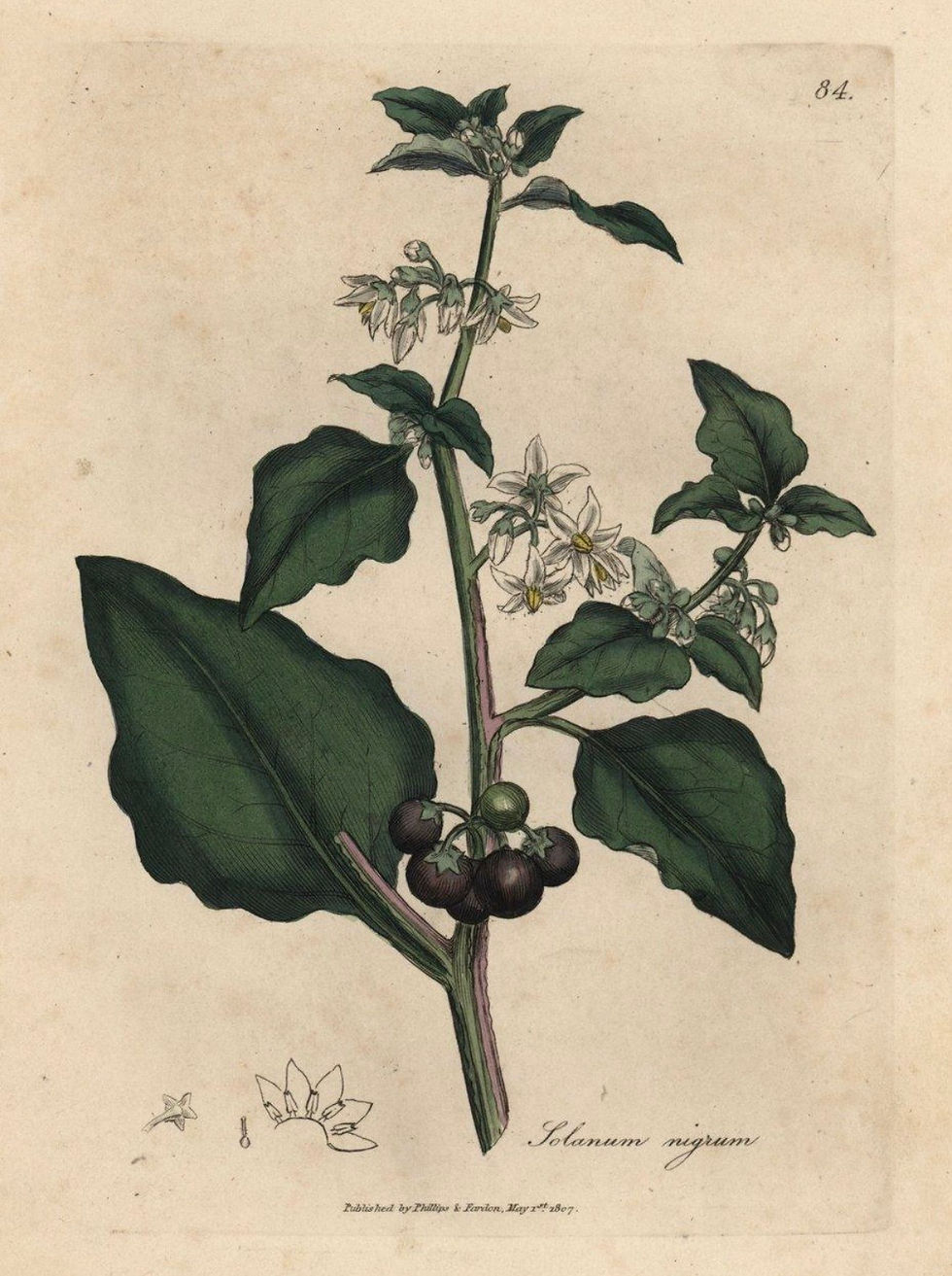
Its flowers are small and white, shaped like little stars. Its branches are unassuming. Its berries begin green and gradually darken until, at maturity, they may appear almost black or purple-black. It is the sort of plant that can pass unnoticed at the edge of a garden or along a neglected path. Kew describes it as a widespread plant of cultivated ground, gardens, roadsides and other disturbed places. (Plants of the World Online)
Yet this modest plant belongs to one of the most storied families in the herbal tradition:
the nightshades.
The name of the night
The genus Solanum has a history reaching back to the botanical literature of the eighteenth century. Linnaeus published Solanum nigrum in 1753, and the species remains accepted under that name today. (Plants of the World Online)
The older language surrounding the plant is less tidy.
Names such as morella, solanum, black nightshade, fox grape, yerba mora, and other regional names have been applied to plants within the black-nightshade group. Some names that once appeared to refer to separate species have subsequently been treated as synonyms of Solanum nigrum. (Plants of the World Online)
This matters when we enter the world of old herbals.
A medieval herbalist did not have Linnaeus’s binomial system, DNA sequencing, or modern taxonomic keys. A word such as “nightshade” could encompass plants that modern botanists would distinguish from one another.
So the old stories must be approached like fragments of an illuminated manuscript: beautiful, suggestive, but requiring careful interpretation.
The little white stars
Perhaps the strangest contrast is between the flower and the fruit.
The flower is pale.
Almost innocent.
Five white petals spread around a yellow center, giving it the appearance of a tiny star.
Then comes the berry.
Green at first.
Then darker.
Until the plant carries little globes of blackness beneath its leaves.
That transformation seems almost made for folklore.
But the darkness is botanical rather than supernatural. Kew records the mature berries of S. nigrum as typically dull black or purplish-black, while noting that green or yellowish-green forms can also occur. (Plants of the World Online)
The plant’s appearance helped give rise to its many common names, but its reputation was also shaped by the larger cultural history of the nightshade family.
Among the nightshades
Solanum nigrum is a member of Solanaceae, the family that includes a remarkable collection of plants with very different relationships to humanity.
Tomato.
Potato.
Tobacco.
Eggplant.
Belladonna.
Henbane.
Mandrake.
Brugmansia.
The family contains plants that have been eaten, cultivated, worshipped, feared, prescribed as medicines, and—under certain circumstances—poisoned people.
That mixture encouraged an enduring fascination with the nightshades.
But black nightshade should not simply be substituted for belladonna, mandrake, or henbane. They are different plants, and their historical uses and chemistry differ.
Indeed, modern taxonomic work has shown just how complicated the black-nightshade group is. A major revision published in 2018 reorganized the Old World black nightshades and clarified numerous names and species boundaries. (Plants of the World Online)
Food and medicine
Here the history becomes especially interesting.
Black nightshade has not belonged exclusively to the world of poison and superstition.
It has also been a food plant.
Kew records Solanum nigrum as being used for food in different regions, as well as having a long history in traditional medicine. Traditional uses recorded in different floristic sources include preparations involving the berries and plant juice. (Plants of the World Online)
At the same time, those same sources preserve warnings about toxicity, including reports of poisonous berries. (Plants of the World Online)
This is an important feature of traditional herbal history.
The old world did not always divide plants into the simple categories we might expect:
food
medicine
poison
The same species could occupy more than one category, depending upon the culture, preparation, plant part, maturity, and circumstances.
That is one reason historical herbalism cannot safely be reconstructed simply by taking an old recipe and reproducing it.
Morella in the shadowed herbals
The word morella carries us deeper into the old European herbal vocabulary.
Kew currently treats Solanum morella as a synonym of Solanum nigrum. (Plants of the World Online)
But the historical name belongs to a much larger linguistic landscape.
Old herbals frequently inherited names from earlier authors, copied descriptions from manuscripts, and sometimes placed different plants under the same vernacular name.
Consequently, when a Renaissance herbal speaks of morella or “nightshade,” the modern reader should resist the temptation to imagine a perfectly identifiable modern species.
Sometimes the name tells us what the herbalist believed.
It does not necessarily tell us what a modern botanist would have collected.
The witch’s garden
And then comes the folklore.
The nightshade family became deeply entangled with European stories of magic, enchantment, poison, and witchcraft.
But black nightshade’s role in that mythology should be treated carefully.
Popular modern accounts sometimes gather together every famous poisonous plant—mandrake, belladonna, henbane, nightshade, datura—and place them all in the same imagined witch’s garden.
The historical reality is more complicated.
There are genuine traditions involving nightshades and magic, and species of Solanum have played roles in spiritual and magical practices in different parts of the world. Kew’s broader treatment of Solanum records species used in magic, spiritual rites, and other cultural practices. (Plants of the World Online)
But it would be misleading to claim that every medieval reference to a “witch’s herb” was specifically Solanum nigrum.
The old names are too fluid for that certainty.
The black berry as symbol
Still, the image endured.
A white flower.
A black berry.
Day turning toward night.
In the language of symbolism, it almost writes its own story.
The little flower resembles a star.
The fruit resembles a dark bead.
And the plant appears in the very places where cultivated land begins to give way to wilderness.
Perhaps this is why black nightshade belongs so naturally in the mythology of the threshold.
It is not the monstrous plant of legend.
It is something more subtle.
A familiar weed with an unfamiliar history.
A plant that can be food in one tradition and medicine in another.
A member of a family whose relatives became some of the most feared plants in European folklore.
And a reminder that nature rarely respects the categories we impose upon it.
The nightshade’s secret
If the mandrake became the plant of the human-shaped root, and Brugmansia became the trumpet of visions, black nightshade might be called:
the plant of the darkening fruit.
It does not need an elaborate myth.
Watch it through the season.
First the tiny white stars.
Then the green berries.
Then the gradual descent into darkness.
The plant seems to perform a miniature drama of transformation beneath the leaves.
And perhaps that is the oldest lesson of the herbal tradition:
a plant does not have to be spectacular to become mysterious.
Sometimes the most enduring stories grow around the things we almost overlook.
Black nightshade is one of them.


Comments