
When Medicine & Poison Were Neighbors: How Earlier Herbalists Understood Dangerous Plants


Today, we tend to imagine medicine and poison as opposites.
One helps.
One harms.
One belongs in a medicine cabinet.
The other belongs behind a warning label.
But for much of human history, the boundary was not so clear.
The dose was not yet a number
Historical herbalists knew that some plants were powerful.
They may not have known the concentration of an alkaloid or the exact mechanism of action, but they could observe effects.
A plant might produce sleep.
Another might relieve pain.
Another might alter breathing.
Another might cause vomiting.
Another might kill.
Traditional knowledge developed partly through this process of observation and transmission.
Modern toxicology grew from the much older human problem of distinguishing edible and useful substances from poisonous ones. (PubMed)
One plant, many possibilities
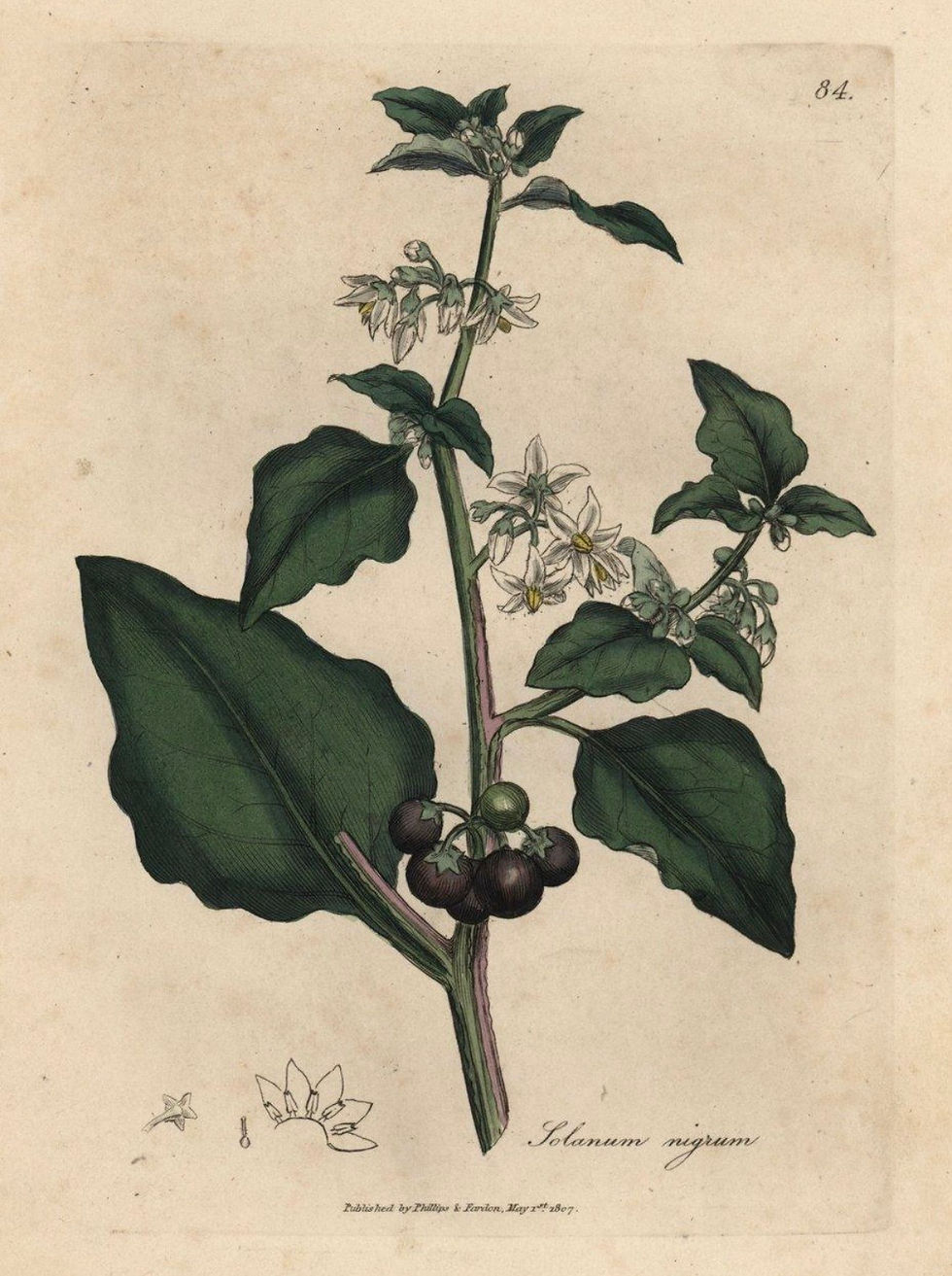
The poisonous Solanaceae demonstrate this particularly well.
Deadly nightshade, henbane, mandrake, and Datura all contain tropane alkaloids.
Today we can describe those compounds and their effects at a molecular level.
Earlier herbalists could only describe what they observed.
And yet those observations became part of the historical record.
This is one reason old herbals are so fascinating.
They are not modern pharmacology textbooks.
They are records of human interaction with plants.
The danger of looking backward
There is a temptation, especially in modern herbal culture, to look at historical medicine and assume that every old remedy was secretly effective.
But history doesn’t support that assumption.
Historical herbalists made observations.
Some were accurate.
Some were incomplete.
Some remedies probably helped.
Some probably did very little.
Some were dangerous.
And some became traditions simply because people continued telling the story.
Studying herbal history does not require believing everything the historical herbalists believed.
It requires listening carefully.
From plant to molecule
The transition from traditional plant medicine to modern pharmacology is one of the most fascinating stories in medicine.
Atropine and related compounds provide a particularly clear example.
Plants containing these compounds had been used for centuries before scientists isolated and studied their active constituents. By the nineteenth century, atropine had become an identifiable chemical substance and eventually an important medicine. (PubMed Central (PMC))
The plant did not suddenly become medicinal when science discovered atropine.
What changed was our ability to isolate, measure, study, standardize, and control the substance.
That distinction is enormously important.
The poison becomes medicine
This is where the phrase “the dose makes the poison” becomes more than a familiar saying.
Many substances have effects that depend upon concentration, route, preparation, and context.
But that doesn’t mean we can safely experiment with poisonous plants to find the boundary.
Modern medicine works precisely because it has developed systems for controlling those variables.
The history of these plants should therefore make us more respectful of pharmacology, not less.
What the old herbalists can teach us
There is still enormous value in studying historical herbalism.
It teaches us to observe.
To record.
To compare.
To ask questions.
To recognize patterns.
It also teaches us humility.
People before us knew things we have forgotten.
They also believed things we now know were incorrect.
Both can be true.
The goal isn’t to decide that the past was wiser or foolish.
The goal is to understand it.
Medicine and poison
Perhaps the most important lesson from the poisonous Solanaceae is that medicine and poison were never truly opposite worlds.
They have always touched.
Plants existed in the middle.
Human beings learned to work with them.
Sometimes successfully.
Sometimes dangerously.
And eventually, through centuries of observation and scientific investigation, some of those plant compounds became part of modern medicine.
The history of herbalism is therefore not simply the history of remedies.
It is also the history of learning what not to use.
And sometimes, learning that distinction was a matter of life and death.


Comments