
Before Modern Toxicology: How People Learned Which Plants Healed, Harmed & Killed


Before there were poison control centers, chemical assays, standardized pharmaceutical doses, or scientists who could identify an alkaloid by name, there were people watching plants, observing animals, learning from one another, and remembering what they discovered. Long before toxicology became a formal scientific discipline, humans were already trying to understand which substances could nourish the body, which could heal it, and which could cause illness or death.
The First Toxicologists Were Observers
The history of toxicology is ancient because the problem it addresses is ancient. Humans needed to distinguish between what could be eaten and what could be harmful, what could be touched safely, and what could be used as medicine. This knowledge was essential for survival, particularly in environments where people depended on wild plants for food, healing, and other practical needs.
The earliest toxicological knowledge was therefore largely experiential. It came from observing the natural world, recognizing patterns, and learning through consequences. Modern historical accounts of toxicology trace its roots to this fundamental human need to distinguish useful substances from poisonous ones.
Learning Through Consequences
Imagine living without botanical field guides, laboratories, or standardized lists of poisonous plants. You encounter an unfamiliar berry, and someone eats it. Something happens, and that experience becomes a source of knowledge. Perhaps a warning is passed down to children, a name develops for the plant, or a community learns to avoid it altogether. In other circumstances, someone might notice that a particular preparation relieves pain, induces sleep, or alters perception.
Over generations, these observations become part of traditional knowledge. Not every conclusion would have been correct, and some interpretations may have been shaped by cultural beliefs rather than biological evidence. Nevertheless, many observations were remarkably perceptive. People could recognize patterns in the effects of plants long before they understood the chemical compounds responsible for them.
The Nightshades as Teachers
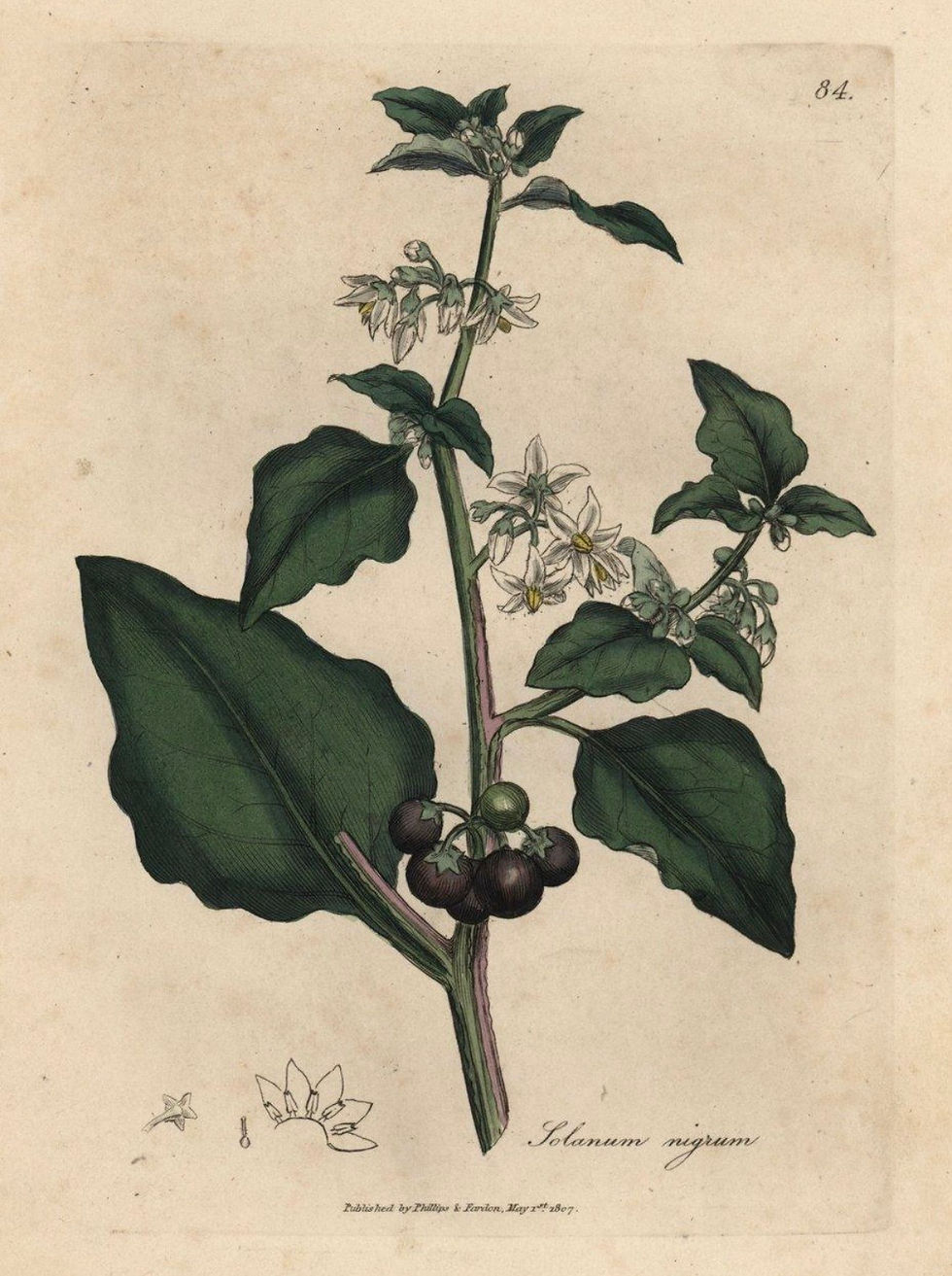
The poisonous members of the Solanaceae family provide a remarkable window into this process. Throughout history, people encountered plants that affected the pupils, altered consciousness, induced sleep, caused confusion, relieved certain symptoms, or produced severe poisoning. Long before the active compounds were isolated, humans were already observing and describing the physiological effects of these plants.
Eventually, scientific investigation began translating those observations into chemistry and physiology. Tropane alkaloids such as atropine, hyoscyamine, and scopolamine became identifiable substances with measurable biological effects. Researchers could investigate how these compounds interacted with the body, why they produced particular symptoms, and how their effects differed according to the substance and the amount of exposure.
What had once been described through experience could now be investigated at the molecular level. The plant had not changed, but our ability to understand its effects had transformed dramatically.
From Warning to Science
A traditional warning might simply say, “Do not eat this plant.” Modern toxicology asks a much more detailed set of questions. Which compound causes the toxicity? How does it enter the body, and how is it absorbed and distributed? Which receptors or physiological systems does it affect? How much exposure occurred, what symptoms might develop, and what treatments are appropriate?
The questions became increasingly precise as scientific methods improved, but the underlying concern remained the same: understanding the relationship between substances and the human body. Toxicology developed by building upon the fundamental observations that people had made long before the existence of modern laboratories.
This progression also illustrates an important distinction between recognizing an effect and understanding its cause. A person may accurately observe that a plant causes confusion or changes pupil size without knowing which chemical is responsible. Modern science helps explain those observations, test possible mechanisms, and determine the circumstances under which particular effects occur.
Knowledge Is Cumulative
One of the most compelling aspects of the history of science is that modern knowledge did not appear from nowhere. It developed through generations of observations made by physicians, farmers, healers, naturalists, and communities whose daily lives depended on understanding the plants around them. Some people learned through careful observation, others through experimentation, and still others through painful or dangerous experiences.
In many cultures, knowledge about plants was preserved through oral traditions, practical instruction, and accumulated experience. Communities remembered which plants were useful, which required caution, and which were associated with illness or death. This knowledge was not always uniform, and its accuracy varied, but it formed part of the historical landscape in which more systematic investigations eventually developed.
Science provided better tools for evaluating these observations. Chemical analysis, controlled experiments, physiological research, and clinical investigation made it possible to distinguish between effects that could be demonstrated and claims that remained uncertain. Recognizing the historical importance of traditional knowledge does not mean assuming that every traditional belief was correct. Rather, it means acknowledging that the history of scientific understanding includes the observations and experiences that preceded formal scientific methods.
Why This Matters Now
Today, information about plants is everywhere. A person can search for a plant’s name and encounter hundreds of claims within minutes, ranging from traditional uses and historical accounts to laboratory findings and commercial promises. Yet the availability of information does not automatically make that information reliable.
A historical claim is not necessarily scientific evidence, and a traditional use is not proof of safety or effectiveness. Similarly, a laboratory study demonstrating that a compound has a particular biological effect does not automatically establish that a plant preparation will be clinically effective in humans. The concentration of active compounds, the method of preparation, the route of exposure, and the characteristics of the individual can all influence the outcome. Even an appealing photograph cannot guarantee that a plant has been correctly identified.
The history of toxicology offers a reason to slow down and evaluate what we encounter. We must ask where a claim originated, how it was investigated, whether the evidence supports the conclusion, and what uncertainties remain. Distinguishing observation, tradition, hypothesis, and established evidence is essential to understanding plants responsibly, particularly when their medicinal properties and toxic effects are being discussed.
The Oldest Lesson
Perhaps toxicology began with one very simple realization: not everything that grows is meant to be consumed. The idea may sound obvious today, but understanding why certain plants nourish us while others can cause serious harm became one of humanity’s oldest and most enduring scientific questions.
The poisonous nightshades are part of that story. Their histories, cultural associations, and chemical properties reveal the complicated relationship between humans and the botanical world. They remind us that a plant can be fascinating from a historical or scientific perspective while also demanding caution and respect.
To know a plant is not simply to know its name or recognize its appearance. It is to understand its place in the landscape, its ecological relationships, its history, its biological properties, and its potential risks. That understanding requires curiosity, careful observation, and a willingness to question what we think we know.
In that sense, botanical wisdom and toxicology share a common beginning: the recognition that understanding the natural world requires more than observation alone. It requires us to learn from experience, test our assumptions, preserve useful knowledge, and approach the unfamiliar with both curiosity and caution.
Continue Exploring October in the Apothecary
Poisonous Plants, Medicine & Myth
Old plants, strange histories, medicine, mythology, folklore, and the stories humans have woven around the botanical world.
Haunted Trails & Forgotten Places
Old paths, forgotten places, local history, and the stories that linger in landscapes long after the people have gone.
More October stories will be added throughout the month.

Comments